3.05 - Shared Memory
Shared Memory
Looking at atomics, thread synchronization, and thread hierarchies, it makes sense why we need all of thees controls in place. One natural question is "why do we need this hierarchy in the first place?"
A natural answer to this is just easy human intuition, but realistically the hierarchy is tied to memory management. Understanding which threads have access to what memory, and how threads work with process memory makes all of this a bit clearer. Threads share process memory space, and each thread spawned by a process has the same general heap and stack memory allocated to it on the CPU, but how does this work on GPU?
GPU's are composed of uniform memory blocks called streaming multiprocessors (SM). Each SM has many cores, and local L1 cache. Global GPU Memory lives outside of these streaming multiprocessors (i.e. global)
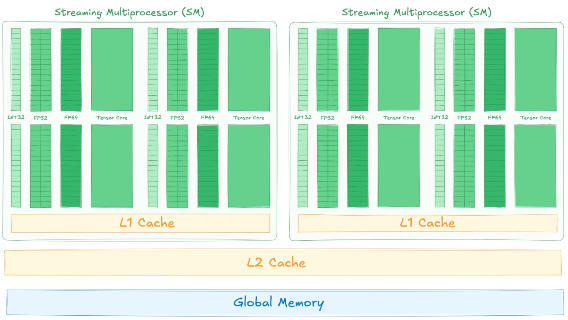
Thread blocks are tied to these streaming multiprocessors, and so we can utilize shared memory, which is co-located to L1 cache on a streaming multiprocessor. Shared memory is directly accessible and usable by threads within thread blocks, and ensures we don't have queue of operations on L2 shared memory that we don't need
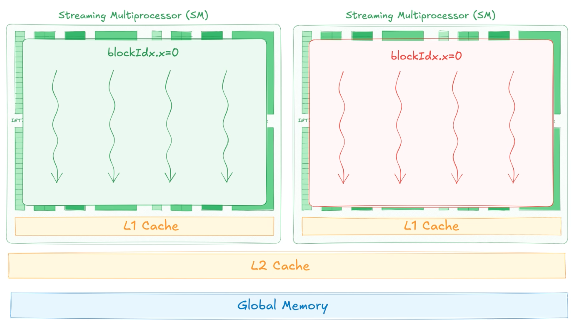
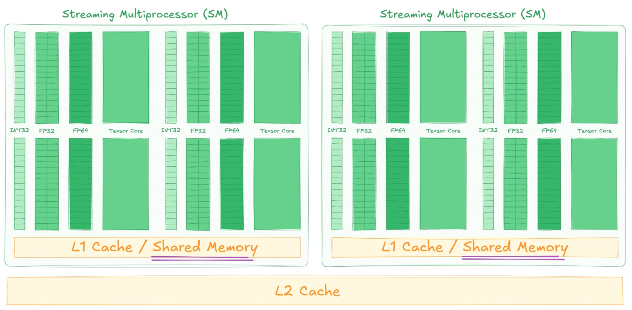
To allocate shared memory, we just use __shared__ with variable declaration!
#include "dli.cuh"

constexpr int num_bins = 10;
constexpr float bin_width = 10;

__global__ void histogram_kernel(cuda::std::span<float> temperatures,
                                 cuda::std::span<int> histogram) {
  __shared__ int block_histogram[10];

  if (threadIdx.x < 10) {
    block_histogram[threadIdx.x] = 0;
  }

  // why here?
  __syncthreads();

  int cell = blockIdx.x * blockDim.x + threadIdx.x;
  int bin = static_cast<int>(temperatures[cell] / 10);

  // get an atomic reference to l1 shared memory in thread block
  cuda::atomic_ref<int, cuda::thread_scope_block> block_ref(
      block_histogram[bin]);

  // add 1 to it
  block_ref.fetch_add(1);

  // ensure all threads have reached here in thread block
  __syncthreads();

  // add the resulting local to global (device) data structure
  if (threadIdx.x < 10) {
    cuda::atomic_ref<int, cuda::thread_scope_device> ref(
        histogram[threadIdx.x]);
    ref.fetch_add(block_histogram[threadIdx.x]);
  }
}

void histogram(cuda::std::span<float> temperatures,
               cuda::std::span<int> block_histograms,
               cuda::std::span<int> histogram, cudaStream_t stream) {
  int block_size = 256;
  int grid_size = cuda::ceil_div(temperatures.size(), block_size);
  histogram_kernel<<<grid_size, block_size, 0, stream>>>(temperatures,
                                                         histogram);
}