3.06 - Cooperative Algorithm
Cooperative Algorithm
- In a serial program, one thread invokes an algorithm and another thread executes it
- In a cooperative algorithm many threads invoke algorithms and many threads execute algorithms
- In parallel algorithms one thread invokes an algorithm and many threads execute it
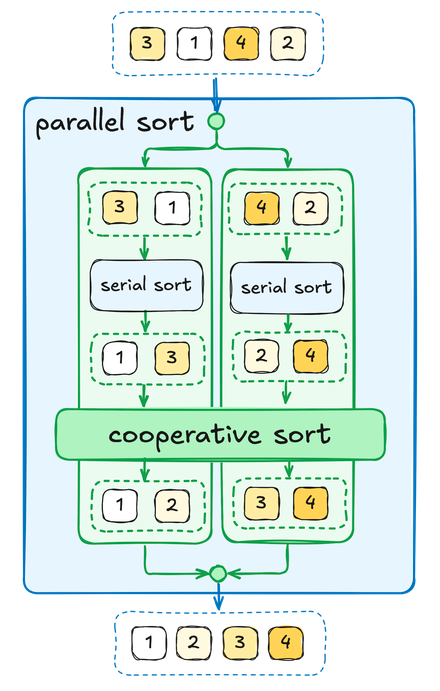
These problems can (usually) be divided and conquered which means each thread can simply choose a small part of the input to work on (cooperative), and on it's own little slice of the world it can run serial algorithms
CUDA provides a huge number of these algorithms out of the box, and most of them interface with each other quite well:
cuBLASDx: provides cooperative linear algebra functions inside CUDA kernelscuFFTDx: provides fast cooperative Fourier Transform inside CUDA kernelsCUB: provides cooperative general-purpose algorithms inside CUDA kernels- ...
Taking CUB as an example, it provides both parallel and cooperative algorithms. It's block level reduction (meaning thread block level reducer) function interface can be summarized below. The nested TempStorage type provides a type of temporary storage needed by cooperative algorithms for thread communication, and an instance of this needs to be allocated in shared (L2) memory
template <typename T, int BlockDimX>
struct cub::BlockReduce
{
  struct TempStorage { ... };

  __device__ BlockReduce(TempStorage& temp_storage) { ... }

  __device__ T Sum(T input) { return ...; }
}

__shared__ cub::BlockReduce<int, 4>::TempStorage storage;
int block_sum = cub::BlockReduce<int, 4>(storage).Sum(threadIdx.x)
Exercise
#include "dli.cuh"

constexpr int block_size = 256; //thread block size
constexpr int items_per_thread = 1; //number of items to compute per thread
constexpr int num_bins = 10; // histogram bins
constexpr float bin_width = 10;

__global__ void histogram_kernel(cuda::std::span<float> temperatures,
                                 cuda::std::span<int> histogram) {
  // shared L1 cache int array
  __shared__ int block_histogram[num_bins];

  // get specific cell to update
  int cell = blockIdx.x * blockDim.x + threadIdx.x;
  int bins[items_per_thread] = {
      static_cast<int>(temperatures[cell] / bin_width)};

  //
  using histogram_t =
      cub::BlockHistogram<int, block_size, items_per_thread, num_bins,
                          cub::BlockHistogramAlgorithm::BLOCK_HISTO_ATOMIC>;
  __shared__ typename histogram_t::TempStorage temp_storage; //idk wtf this is
  histogram_t(temp_storage).Histogram(bins, block_histogram);

  // ensure all threads have reached here
  __syncthreads();
  if (threadIdx.x < num_bins) {
    cuda::atomic_ref<int, cuda::thread_scope_device> ref(
        histogram[threadIdx.x]);
    ref.fetch_add(block_histogram[threadIdx.x]);
  }
}

void histogram(cuda::std::span<float> temperatures,
               cuda::std::span<int> histogram, cudaStream_t stream) {
  int grid_size = cuda::ceil_div(temperatures.size(), block_size);
  histogram_kernel<<<grid_size, block_size, 0, stream>>>(temperatures,
                                                         histogram);
}