1.06 - Memory Spaces
Exercise - Memory Spaces
A universal vector in thrust essentially keeps two copies of the same data, both on CPU and GPU. Managed memory abstracts away the fact that GPU and CPU have distinct memory spaces, and so imlpicit memory transfer between memory spaces happens upon accessing that memory in kernel code
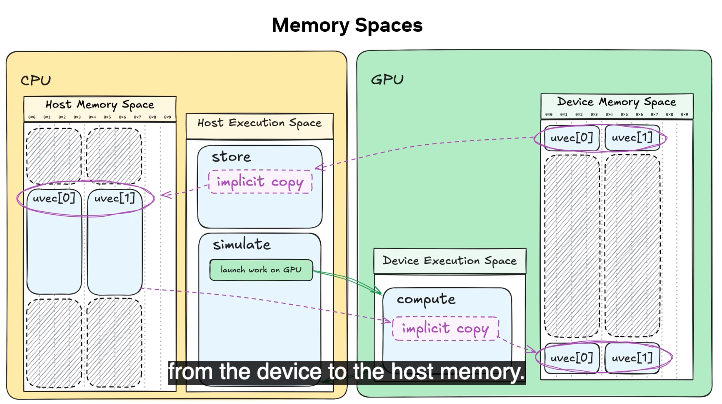
When the host calls store on CPU, and data is sitting on device memory, CUDA needs to move the data from device to host memory. Once store finishes, the GPU needs to run the next transformation, which means CUDA needs to copy the CPU data back onto the device
Essentially there's a continuous flip flop between CPU and GPU having the "valid" data, and it keeps having to copy the entire thing back and forth
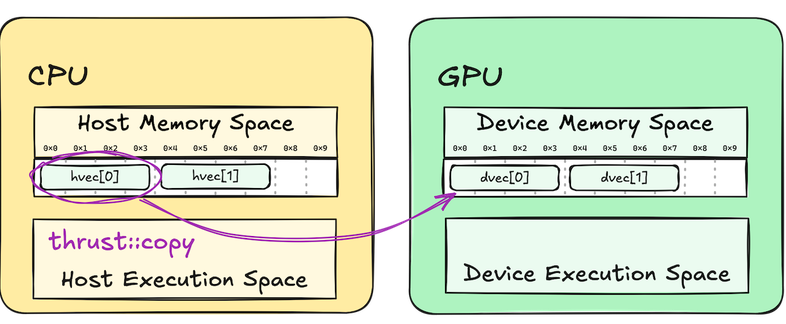
Both vectors below are only accessible on the specific device it's constructed on:
thrust::host_vectorconstructs and hosts the vector on CPU memorythrust::device_vectorconstructs the vector on CPU, but allocates the vector on GPU memorythrust::copycan transfer between device and host as needed
The flip flop can be seen in the computation metrics below for the following input code:
computed step 0 in 0.0265328 s
computed step 1 in 0.000513304 s
computed step 2 in 0.000507332 s
   write step 1
computed step 0 in 0.0265666 s
computed step 1 in 0.000512392 s
computed step 2 in 0.000514396 s
   write step 2
computed step 0 in 0.0277668 s
computed step 1 in 0.000512602 s
computed step 2 in 0.000507442 s
dli::store and dli::simulate keep copying data back and forth between CPU and GPU, which invalidates it on the other piece of hardware. That's why the first simulation on each step is so much longer than the rest
%%writefile Sources/heat-2D.cu
#include "dli.h"

int main()
{
  int height = 4096;
  int width  = 4096;

  thrust::universal_vector<float> prev = dli::init(height, width);
  thrust::universal_vector<float> next(height * width);

  for (int write_step = 0; write_step < 3; write_step++) {
    std::printf("   write step %d\n", write_step);
    dli::store(write_step, height, width, prev);

    for (int compute_step = 0; compute_step < 3; compute_step++) {
      auto begin = std::chrono::high_resolution_clock::now();
      dli::simulate(height, width, prev, next);
      auto end = std::chrono::high_resolution_clock::now();
      auto seconds = std::chrono::duration<double>(end - begin).count();
      std::printf("computed step %d in %g s\n", compute_step, seconds);
      prev.swap(next);
    }
  }
}
All of this can be tweaked and managed inside of CUDA via:
thrust::host_vector<int> h_vec{ 11, 12 };
thrust::device_vector<int> d_vec{ 21, 22 };
thrust::copy_n(h_vec.begin(), 1, d_vec.begin())
Exercise Input
%%writefile Sources/heat-2D-explicit-memory-spaces.cu
#include "dli.h"

int main()
{
  int height = 4096;
  int width  = 4096;

  thrust::universal_vector<float> prev = dli::init(height, width);
  thrust::universal_vector<float> next(height * width);

  for (int write_step = 0; write_step < 3; write_step++) {
    std::printf("   write step %d\n", write_step);
    dli::store(write_step, height, width, prev);

    for (int compute_step = 0; compute_step < 3; compute_step++) {
      auto begin = std::chrono::high_resolution_clock::now();
      dli::simulate(height, width, prev, next);
      auto end = std::chrono::high_resolution_clock::now();
      auto seconds = std::chrono::duration<double>(end - begin).count();
      std::printf("computed step %d in %g s\n", compute_step, seconds);
      prev.swap(next);
    }
  }
}
Solution
Just need to change prev and next to be device vectors, and write them to a to_write host vector that we copy data over to
%%writefile Sources/heat-2D-explicit-memory-spaces.cu
#include "dli.h"

int main()
{
  int height = 4096;
  int width  = 4096;

  thrust::device_vector<float> prev = dli::init(height, width);
  thrust::device_vector<float> next(height * width);

  for (int write_step = 0; write_step < 3; write_step++) {
    std::printf("   write step %d\n", write_step);
    thrust::host_vector<float> to_write(height * width);
    thrust::copy(prev.begin(), prev.end(), to_write.begin());

    dli::store(write_step, height, width, to_write);


    for (int compute_step = 0; compute_step < 3; compute_step++) {
      auto begin = std::chrono::high_resolution_clock::now();
      dli::simulate(height, width, prev, next);
      auto end = std::chrono::high_resolution_clock::now();
      auto seconds = std::chrono::duration<double>(end - begin).count();
      std::printf("computed step %d in %g s\n", compute_step, seconds);
      prev.swap(next);
    }
  }
}