GPT(s)
GPTs
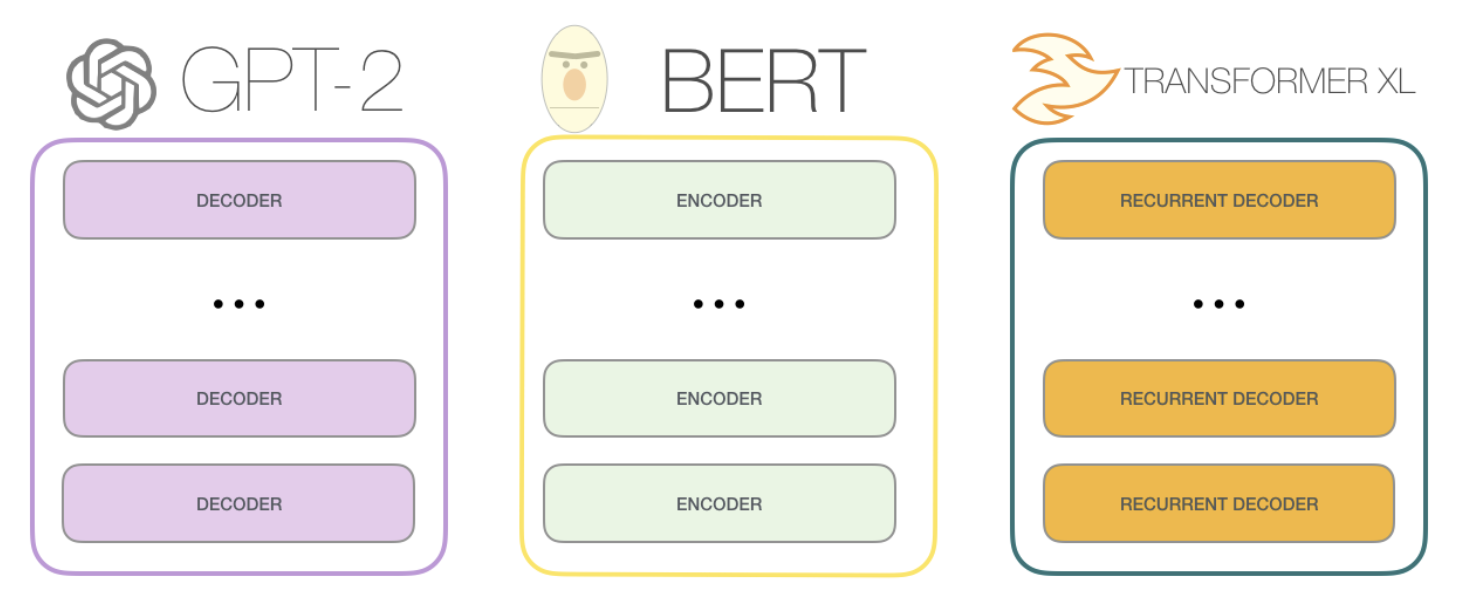
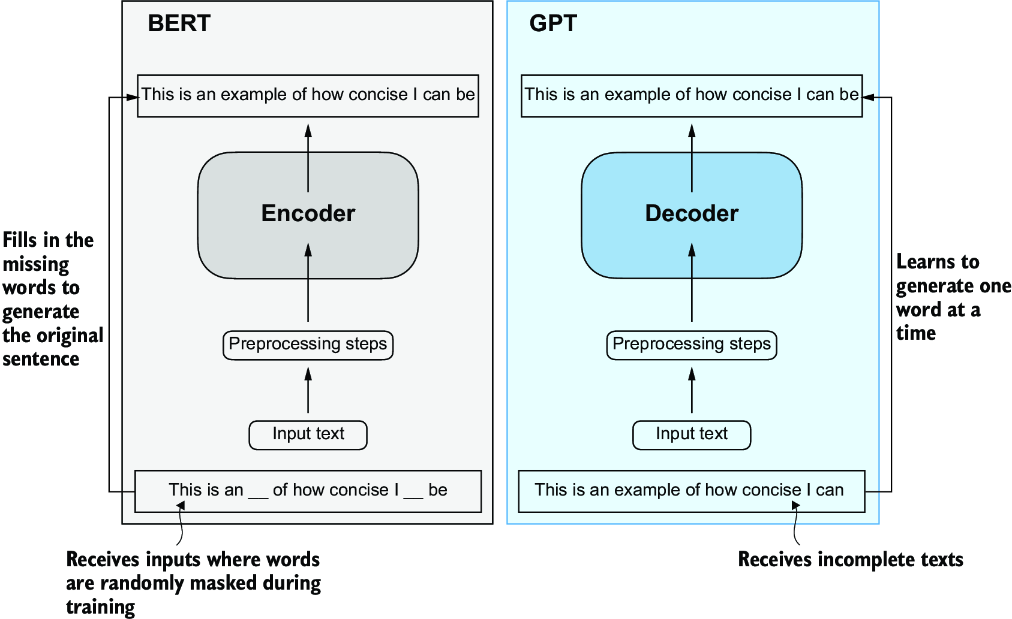
The GPT models are a decoder only (no cross encoder-decoder attention, no encoder hidden states) transformers. Their use in language modeling was created from the same overall desires of BERT and Transformers, where we want to use "web scale" data in an unsupervised fashion to gain an edge over supervised tasks that require curated datasets
- GPT 1 - Improving Language Understanding by Generative Pre-Training introduced the idea of generative pre-training followed by discriminative fine-tuning. Unsupervised pre-training is used for general language modeling, similar to the pre-training desires in BERT, however only a decoder is used. Afterwards, the model is then saved and utilized for supervised fine tuning tasks, and those tasks need to be altered to fit into the pre-training generative architecture
- Classification is simply "generate a single word text description of the input"
- Named Entity Recognition is simply "generate a CSV list of named entities in the input"
- Similarity is outputting two results and comparing their similarity (this is still weird)
- etc
- GPT 2 - Language Models are Unsupervised Multitask Learners is mostly a larger extension of GPT 1, and furthers the idea of unsupervised learning taking over. It does this by essentially throwing out the downstream supervised fine tuning, and hypothesizing "all downstream fine tuning tasks can be modeled as next token generative output with enough data". In doing so, zero-shot prompting emerges where we give the model an explicit task definition in the prompt for it to output the correct sequence
- "zero-shot task performance emerged from simply conditioning the language model with text, reducing the need for task-specific fine-tuning"
- Zero shot is an important caveat because not updating weights means it can generalize to all of these tasks via contextual prompts alone, and not gradient updates
- GPT 3 takes it a step further from "GPT 2 can do tasks from prompts" to "GPT 3 can learn tasks from examples in the prompt". Meaning if you give the prompt some general set of translations, GPT 3 will understand it needs to do a translation task simply from the input output pairs. There are a few new vocabulary terms:
- Few-shot prompting is just an extension of zero and one shot, meaning you provide more than one example in the prompt
- In-context learning means that GPT 3 can infer the task from the context (in context) and doesn't do any weight updates (it says learning, but it specifically does not update weights)
- This is an important caveat because not updating weights means it can generalize to all of these tasks via contextual prompts alone, and not gradient updates (I know this is a repeat, but it's of importance)
- Meta learning is a buzz phrase saying GPT 3 can learn to learn, i.e. it has learned how to infer the task from the contextual prompt
Going from GPT 1 to GPT 2 showed we can remove any fine tuning heads, and that GPT 2 itself can handle all sorts of tasks without gradient updates. Simply framing any task as a generative output sequence, and showing GPT 2 had state of the art results, proved a major breakthrough. From GPT 2 to GPT 3 there wasn't a major breakthrough except a much larger model, larger context, etc, which meant we could simply push task examples into the prompt without writing it by hand. GPT 3 can infer what it needs to do from examples, which means it is much easier to automate as a system versus a human writing things out by hand
It should be clear that GPT models generate text. They typically aren't a great replacement for encoder only models, like BERT, for other NLP tasks such as classification, document retrieval, similarity, etc. These NLP tasks utilizing an encoder only model + fine tuned head are much cheaper, more accurate, deterministic, etc compared to decoder models, but the GPT models did show that broad Seq2Seq tasks can be handled exceptionally well by generative language modeling alone. Altogether, the GPT models allow for a humongous range of NLP tasks to be done by a singular interface; They are a one size fits all solution, but they are not the most efficient solution for everything
These families introduced training and alignment objectives to further the zero-shot abilities. Web scale data is great, but the actual structure of generative output needed some structure
- Instruct GPT extends GPT 3. GPT 3 can infer what task it should do from prompts, but that isn't the same objective as "do what the human asks". InstructGPT starts getting into human preference, reinforcement learning with human feedback (RLHF), and other alignment architectures
- GPT 3 can infer from the prompt what task needs to be done, but GPT 3 was more focused on plausible continuations (i.e. task pattern and continuation), which may be inherently different from structuring it to what a human needs
- InstructGPT helps to make it reliably do what humans ask it in the prompt
GPT 1
GPT 1 was modeled as a modified decoder only transformer. If the input to a GPT is of size , it needs to run multi headed, and multi layered, self attention over these inputs, along with the typical residual blocks, layer norm, dropouts layers, etc. After this is done, there is a softmax function at the end to predict the next word from the vocabulary set
Unsupervised Pre Training
During unsupervised training, this will continuously run as an auto-regressive unsupervised modeling framework. Similar to BERT it has a context window of size , but it only uses the self-attention parts of a decoder to output words until it predicts an [EOS] token and then stops. Loss during this is predicted over each predicted output, simply as a language model does!
is the context window, and the conditional probability is modeled with some parameters , updated via backpropogation over the many decoder only layers. The general architecture utilizes parameters:
- is context size
- the general size of vectors in the embedding matrix , and the hidden state vector sizes
- is the context vector of tokens, each being
- is the token embedding matrix, producing vectors of size
- is the position embedding matrix
The end result from softmax is basically choosing a vector from the token embedding matrix
This will train a generalized language model over web scale data!
Supervised Fine Tuning
This is generally the "meat" of the paper, which hypothesizes that the final layer can simply be fed into an additional linear output layer with a new parameter set to predict a label
This is important because it generalizes a labeled dataset with:
- Sequence of input tokens
- A label
The above is an extremely vague dataset! This is on purpose, and is the desired feature of this model. Even if is not in our token embedding matrix , we only need to ensure the new parameter set includes it, along with all of the seen vocabulary words from unsupervised pre-training.
Which leads to a loss over all the generated outputs that make up the actual required output label. The softmax at the end produces a distribution over the task specific outputs
The authors also include language modeling as an auxilary objective, outside of just predicting the output sequence
The Meat of GPT 1
We can use the unsupervised pre-trained language model to produce without any changes to it! All we have to do is create a new mapping / output parameter set , and we can use the underlying language model to predict any sequence of output tokens. Even if the correct output is multiple values long, we can generate any sequence of outputs given the generative nature!
This is where "classification is only outputting a single word" and "named entity recognition is just outputting a CSV list of named entities" - since the objective is just to output a sequence of tokens, GPT 1 can generalize to a humongous set of fine-tuning tasks
The only extra parameters we require during fine tuning are
Some online documents mention supervised fine tuning only creates a singular classification style output, others mention is allows for generative sequence creation, and the loss is the same as over all of the predicted tokens in the sequence. From the GPT 1 Paper the supervised fine tuning task was typically done for a classification / discrete size result. The can be shrunk to a set of classes instead of tokens, and then GPT 1 would be doing transfer learning from it's final hidden state into a classification head! Other tasks were also included in this by simply utilizing to ensure the final projections allowed it to utilize an appropriate loss function, and also to validate results against other models
GPT 1 uses task specific input transformations to ensure any task input is turned into a sequence the transformer architecture can use, and then the output layer is used to take the output from the decoder only transformer and project it into an appropriate output
Task Specific Transformations
Modeling the tasks to just be sequence outputs required some tweaking, but it's very easy to see. Hell, even regression can be considered an output if it just produced a string representing "12.4"!
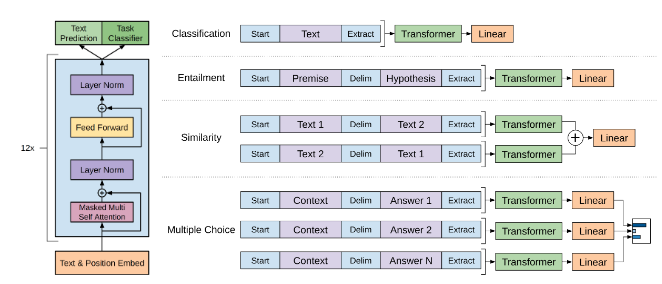
The harder to notice portion is representing the input and outputs appropriately:
- Text classification is simple, you just output a single class (maybe multiple words)
- Question Answering means structuring the input as a question, and the output as a sentence answer
- Textual Entailment (using a set of defined rules to reason) means we need a triplet of
(inputs, documents, answers)where the documents are used in reasoning
The actual creation of all of these for each task was a large body of work described in the papers
GPT 2
GPT 2 TLDR is very simple:
- Beef up unsupervised pre-training. More parameters, larger model, more data
- Remove task-specific supervised fine tuning, and frame downstream tasks as textual conditioning + completion with zero shot prompting
- Essentially, similar to entailment, you give the input a set of rules / structure of output and it can use that information to predict an output sequence
- This output sequence + zero shot prompting gets rid of anything task specific! The task itself is specified through the prompt / context rather than a specific head
It is nice that the GPT models mostly just get bigger. More power. And otherwise just become more generic by saying "what is a task? It's just a sequence" and modeling almost every possible task into a sequence with a nice loss function. The loss function is important, because the loss of summarization is slightly different than the loss for named entity recognition - summarization loss is actually quite hard to pin down, and NER has a set of values you could use cross-entropy loss in a classical setting. That being said, GPT 2 only does the unsupervised pre-training portion, so it's loss is still just:
GPT 2 Validation and Experiments
Most GPT 2 experiments utilize language modeling datasets, and so summarization, question answering, etc are all easy to validate with simple loss functions. They actually made their life much easier in terms of dropping the task specific heads and just generalizing to the language modeling loss
GPT 2 experiments include:
- Translation - BLEU score
- Question answering - Exact match
- Summarization - ROUGE
- Reading comprehension - Exact match / related metrics
- etc
Therefore, GPT 2 just needs to output the sequence in the same way it would during unsupervised pre-training, and all of these datasets have validation metrics to utilize to compare the output sequence to the desired one. Zero shot means during these experiments / validations, no weights are updated!
New Definitions and Vocabulary
In GPT 2 a few new vocabulary words come out:
Zero shot means without any parameter or architecture modification. It's just useful to explain models don't have to update parameters
- Each of the downstream "tasks" is now zero-shot meaning they send in a set of instructions in the input, and there's no update to parameters needed
The conditional probabilities utilized in GPT 1 for generating the next word now go beyond just the input sequence
Byte Pair Encoding is used to reduce the total size of the vocabulary and embedding matrix . Because our output is a generic sequence, we don't have to store "read", "reading", "reader", "creep", "creeping", and "creeper" - we can just store "read", "creep", "##ing", and "##er". It even goes a bit further to split words based on common middle parts too, but ultimately this allows any output sequence to be modeled at a sequence of common bytes which drastically reduces the memory of the models vocabulary and lookup times