Ray
Ray
Ray is another open source framework for scaling AI and Python applications, typically used in parallel processing for ML workloads
Most Python multiprocessing is done utilizing multiprocessing in tutorials and other demonstrations, but actually creating a distributed Python application with communication overhead, data shuffling, network I/O, high availability, etc requires something a bit more robust - this is the use case of Ray
Ray focuses on taking functions and classes from typical Python programs, and translating them into workers, tasks, and actors
- A worker is the underlying compute process,
- Tasks are the unit of work scheduled by Ray and correspond to a stateless function invocation or method invocation
- Actors are the long running services tied to a dedicated worker. Actors are the specific classes themselves that perform tasks which are invoked functions that need to run
- To perform tasks, actors need a few things:
- Shared memory stores help to share objects between workers without creating copies
- In memory databases for storing metadata about other workers
- Local network
eth0access or some sort of networking device
Actors are classes we define in Python, many actors can be spawned in a cluster across nodes. Nodes have multiple CPU's, GPU's, etc and when you instantiate a new actor, Ray creates a new worker and schedules methods of the actor on that specific worker. A worker is a physical OS process spawned on a cluster node to execute code, an actor is always tied to 1 single worker, and each worker is tied to a process on a node
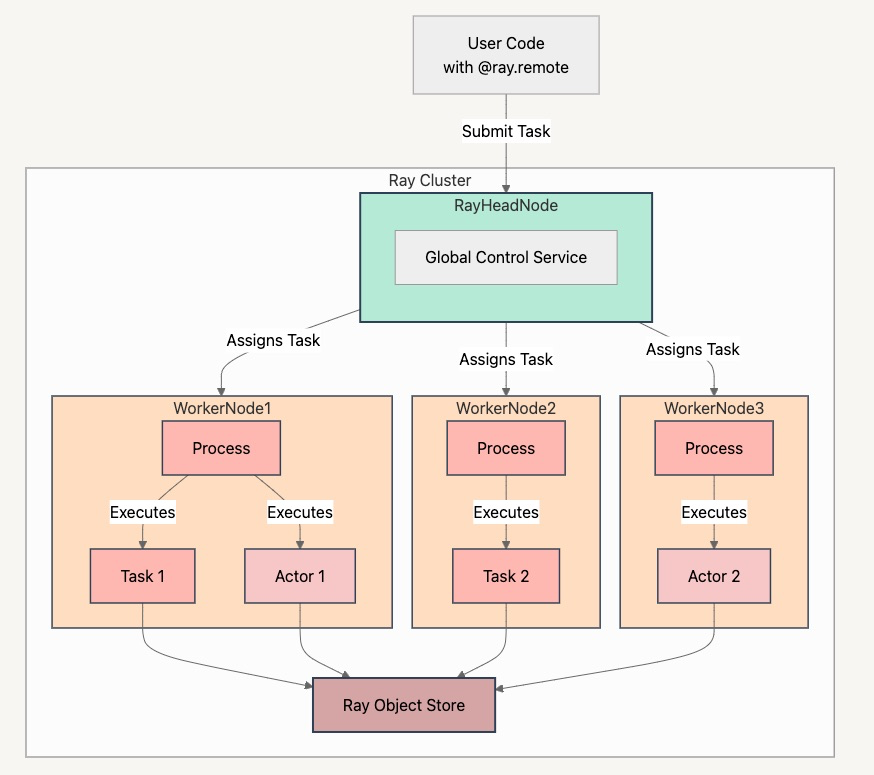
Workers
Workers are python processes that run on an Actor
Tasks
To actually run a function func() as a parallel, remote, and / or asynchronous call it needs to be decorated with @ray.remote - these will return futures, and then the actual function call will take place in the background as a Task
Tasks can then depend on other tasks, and so forcing one task to be dependent on others means it won't execute until the dependent ones return - i.e. tasks are a DAG
Actors
Classes are extended to be actors with the same @ray.remote decorator. Whenever the new class is instantiated, Ray created a new Actor which is mostlt just a process that runs somewhere in the cluster, as scheduled by the scheduler, and holds a copy of the object
Method invocations on that actor turn into tasks that run on the actor process and can access and mutate the state of the actor. Therefore, actors have mutable state that can be shared across tasks that it runs. Individual actors execute methods serially like a normal Python process does, and so there aren't any race conditions inside of an actor
Therefore parallelism can be created by having multiple actors! Simply having multiple of them draining queue's and processing images, handling inference calls to respond with GPU based models, etc! It's all similar to running multiple python workers / processes, the major difference is in sharing objects / state across the actors in an efficient way and scheduling work to be done
Actor Handles
Actor handles allow other actors / tasks to invoke methods (start tasks) on the initial actor - meaning if actor B wants to start a task on actor A it can invoke actor A's handle
This can naturally be used for having a central queue actor, having a central message actor, etc that gets pushed to or pulled from