6. Binary Search
Binary Search
lookup on sorted search space!
The entirety of binary search is around being able to find something in time because our data structure is sorted in some way - whether it's a Tree, a List, or a generic search space like the number line (rate of X, number of Y, etc... are just integers that are sorted)
At each step of the way you shrink the search space by half because you know the data structure is sorted in some way - if you were looking for a word in the dictionary that starts with D and you randomly flipped to the letters N, we'd look to the left
If you have some search space, lets say an array arr and there's an element x, then you can find the index idx of x in arr in time and space. Most of the time, searching via binary search is faster because it will beat out
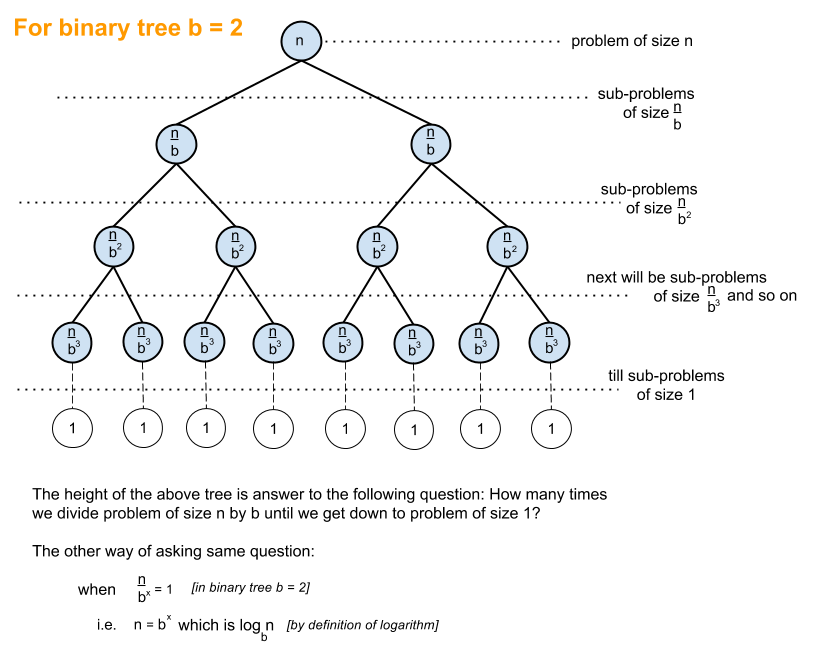
Why is it ? Mostly because if there are elements, and you are constantly splitting it in half, then you'll do at most searches:
I guess that's just repeating the same thing twice - here's a photo:
Templates
There are two common templates:
- Inclusive
[left, right]which utilizes<= - Exclusive open interval
[left, right)which utilizes<
Setting these means the developer decides what the search space means - if you utilize len(arr) you know that it can't actually be apart of the search space - that'd lead to an indexing error. So you're actively choosing to have a search space of [left, right). Left is a candidate, right is not. [left, right) is non-empty exactly when left < right, and if the dumb developer utilizes left <= right, they're allowing for len(arr) to creep in which is wrong. If left == right, left < right is empty and nothing happens
Same argument for [left, right] then
Going to try and utilize the below template as much as possible throughout the doc. This template is 1:1 with bisect_left python implementation, which is a standard function we can also use
def bs(nums, target):
    left = 0
    right = len(arr)

    while left < right:
        mid = left + (right - left) // 2

        # if our number is less
        if nums[mid] < x:
            left = mid + 1

        # greater than or equal to - keep mid for equal to
        else:
            right = mid

    return(left)
There are some cases where left and right updates differ, and it's all dependent on what check() looks for and returns. Sometimes we want to keep items in the search space, other times we +1 and -1 to remove them from the search space when there's absolutely no reason for them
Open Interval Template
Utilizing the open interval template is usually the best for a large majority of problems:
[left, right), where therightindexes are no longer apart of the search space- This does not mean they're out of the answer space
while left < rightensures we never havemidnever equal torightduring an update- If
left = right - 1(i.e. we're in an interval where left and right are right next to each other), then the update happens below:
mid = (right - 1) + (right - (right - 1)) // 2
= (right - 1) + 1 // 2
= (right - 1) + 0
= right - 1- So we will always have
left <= mid < right
- If
This allows us to utilize the right = mid and left = mid + 1 update logic for most of the typical, and some atypical, cases below
Altogether:
- In
[left, right),rightis outside the current search space midis always inside the current search space, withleft <= mid < right- The interval shrinks until
left == right - For boundary-finding problems like first valid item, that final boundary is the answer, so returning left is correct
Intuition
If you have a sorted arr, and you have it's start and end indexes left, right you can continuously check the middle mid = left + right // 2, and based on mid relation to your target you can shrink the search space in half. If mid > target, that means you want to focus to the left and you'll change right = mid - 1, and if mid < target, that means you want to focus to the right and you'll change left = mid + 1
In Java or Cpp you'd use left + (right - left) / 2 so that, in case right = INT_MAX, you don't store something larger than it which would overflow
The template in Python pretty much does just that, but this one is looking for an exact match we expect to be in the array:
def binary_search(arr, target):
    left = 0
    right = len(arr)
    while left < right:
        mid = (left + right) // 2
        if check(mid, arr, target):
            # do something
            return

        # mid for sure isn't in it, so close search space
        #   based on [left, mid) interval
        if arr[mid] > target:
            right = mid
        else:
            # the search space is now surely [mid + 1, right)
            left = mid + 1

    # target is not in arr, but left is at the insertion point
    return left

def check(idx, arr, target):
    return(
        arr[idx] == target
    )
Using len(arr) - 1 means your last valid index is included, and your valid search interval is [left, right]
Using len(arr) means your last valid index is excluded, and your valid search interval is [left, right). The update procedure is high = mid in this scenario if arr[mid] > target because we want to keep the left side in tact. high = mid still removes mid from the search space, because our interval is [left, right)
The main difference is what you return, and how you update your search space:
- If you want to return the exact index you can do that, or you can return an insertion point of where something new should be placed
- You can update your search space based on finding any match, the unique exact match, the first match of some kind, or the last match of some kind
Typical Problem Statements
Some will outright say "find this value in a sorted list" which makes things easy, most won't Other ways to describe it"
- Theres an array of times each train takes
- Array of times it takes to eat a meal
- Given a threshold k, what’s the minimum time each train / meal would take to finish
- Find an element in an array that's been sorted, and then rotated
- Capacity to ship packages within days (f' this one)
Most of these solutions will involve a check() function, where you will propose some item in the search space, like an index or other value, and then quickly check if that value works
For the capacity to ship packages problem, the check() function revolves around checking if the weight capacity can cover the shipping requirements - the check() funciton itself runs in time so it seems slow, but ultimately it's still fast compared to other routes
- In the above classic case,
check()is just comparing the element atarr[idx]totarget
The reason this is "fast" is that in time you can propose capacity values, and then for each of them it takes time to check so the overall solution is . This is faster than iterating from 1 to 2 to 3... capacity which would result in
Typical Patterns And Pitfalls
There are some typical patterns pitfalls that annoyingly come up in almost every review
The main questions to ask:
- What is the search space?
- What does
check(mid)mean? - What is the goal (min valid, max valid, exact match)?
- This will alter the return
- When is mid good/bad? Adjust left/right accordingly
- This will alter our
left =andright =updates
- This will alter our
- Do you return left, right, or mid?
Duplicates
If an input array has duplicates, then you need to tweak the check() function to try and find the first or last position of the desired target
If you have arr = [3, 4, 5, 5, 6, 7]
left = 0right = 5mid = 2, therefore,midpoints to the leftmost 5
Need to now change check() to use arr[mid] >= target - If we want to find the left most value, i.e. the "first occurrence", and we find a mid that matches our target, what do we need to do? We need to move our search space to maximum mid, and keep searching the leftern side for move values - i.e. right = mid
def binary_search(arr, target):
    left = 0
    right = len(arr)
    while left < right:
        mid = (left + right) // 2

        # In the check here, if this "works", we still keep mid involved in the search space
        if check(mid, arr, target):
            right = mid

        # if it absolutely doesn't work, there's no need to keep mid in search space
        else:
            left = mid + 1

    return left

def check(idx, arr, target):
    return(
        arr[idx] >= target
    )
Using len(arr) means your right boundary is past the last valid index, and your valid search interval is [left, right). In this you check left < right
Insertion Vs Index And Bisect Functions
If we are looking to find the insertion index, there's a slight tweak versus finding a specific index and it mostly comes down to how you alter the check() function...as usual...and then the pointer that's returned
A very easy way to do this in python is via the bisect.bisect_left(arr, target) method - the below problem statement and python code shows it
"Given a sorted array of distinct integers and a target value, return the index if the target is found. If not, return the index where it would be if it were inserted in order. You must write an algorithm with O(log n) runtime complexity."
class Solution:
    def searchInsert(self, nums: List[int], target: int) -> int:
        return(bisect.bisect_left(nums, target))
The bisect modules figure out where an element should be inserted to ensure the ordering of the list stays true, while having different semantics for arrays with repeated elements:
- Inserting at a position moves the item in that position to the right
- The
bisect_left(a, x, ...)function takes a sorted list a and a value x and returns an index i such that after insertion:- All elements to the left of the index (
a[:i]) are less than x - All elements to the right of and at the index (
a[i:]) are greater than or equal to x
- All elements to the left of the index (
bisect_righton the other hand will return an index i such that after insertion:- All elements to the left of the index (
a[:i]) are less than or equal to x - All elements to the right of the index (
a[:i]) are greater than x
- All elements to the left of the index (
- So they mostly differ on how they handle equal to, and exact insertion point
- If there was an array
arr = [1, 5, 6, 8]bisect_left(arr, 7)would return 3 as the 2nd index has a value less than it's targetbisect_left(arr, 6)would return 2 as it's the target, so less than or equal tobisect_right(arr, 7)would return 3 as the 2nd index has a value less than it's targetbisect_right(arr, 6)would return 3 as all elements to the left must be less than or equal to 6
Looking at the bisect_left source code, it's exactly our template, except with many more error handling and good coding practices
class Solution:
    def searchInsert(self, nums: List[int], target: int) -> int:
        left = 0
        right = len(nums)
        while left < right:
            mid = left + (right - left) // 2
            if nums[mid] < target:
                left = mid + 1
            else:
                right = mid

        return(left)
The Longest Subsequence With Prefix Sum Problem utilizes bisect_right to find the length of the longest subsequence that's less than or equal to a certain query
- After calculating the prefix sum, the length of longest subsequence is equal to the last index of the prefix sum where we could insert the query
- If the pfx sum has
[1, 4, 7, 8], and our query is 6 or 7, we'd want to return 2
The intuition for pointer updates can be shown at the end of the minimize K section
Solution Spaces
Binary Search can also be used outside of arrays - generically it can be used on any solution space such as integers, some capacity, or anything else. A typical scenario of this is a problem asking "what is the min/max something can be done"
Ultimately, the only true criteria that need to be met for binary search are:
- You can quickly, in or better time, verify if the task if possible for a given input
x - If the task if possible for an input
x, and you are looking for:- A maximum, then it's also possible for all inputs less than
x - A minimum, then it's also possible for all inputs greater than
x
- A maximum, then it's also possible for all inputs less than
- If the task is not possible for an input
x, and you are looking for:- A maximum, then it's also impossible for all inputs greater than
x - A minimum, then it's also impossible for all inputs less than
x
- A maximum, then it's also impossible for all inputs greater than
Statement 1. references the ability to quickly do things, as the check() function needs to be fast enough that we can do better than , and statements 2. and 3. revolve around the search space being able to be "shrunk" via mid updates - if we can't shrink the search space automatically because something's unsorted, or it doesn't make sense, then we cannot do binary search (i.e. we can't cut out that portion of solution space)
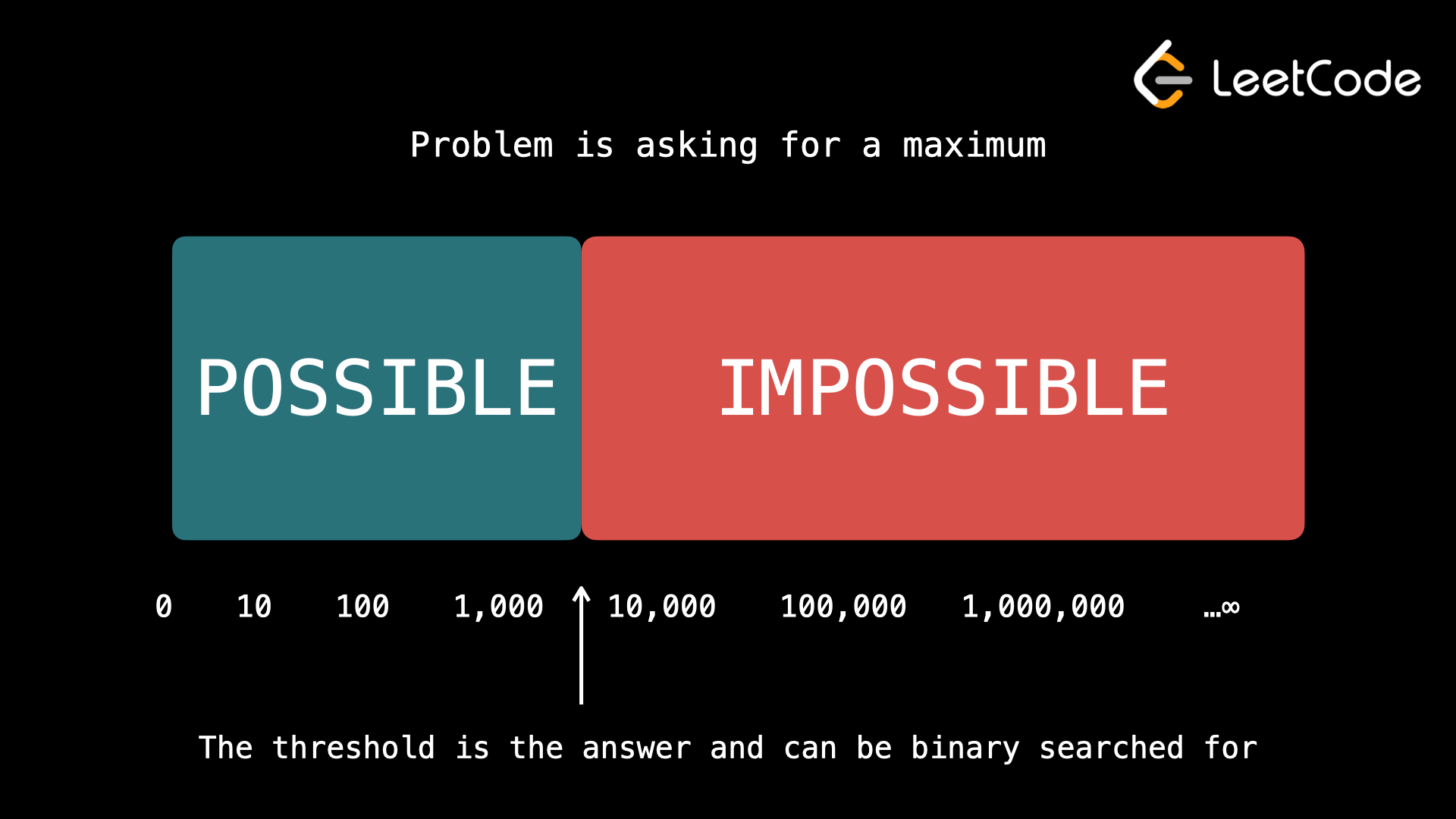
Problems finding a min / max are actually searching for this magic threshold that separates possible from impossible, and that magic threshold is what we're trying to obtain as our output of binary search
Establishing the solution space is typically the hardest part - if you're looking for a min/max rate, how can you decide what "max" is?
- In Koko Eating Bananas Koko only eats a pile at a time maximum, and so the maximum rate can only be the maximum of the piles
max(piles) - In Capacity Planning you can ship as many packages as possible with a specific rate, but the most weight you could process in a single day is the entire weight, so the maximum rate is
sum(weights)
The solution space can be defined by which represents the range of the solution space - sometimes it's , sometimes it's where , etc...
Once you have the figured out, the binary search time complexity becomes
- revolves around the time taken for a check function to run - typically a greedy function that could exhaust the entire input list
- revolves around traversing the search space, where for each traversal we need to run the
check()function
ATypical
There are some weird ones thrown in as well, especially rotating lists, a weird search space, or "guessing" at a condition The important alternate patterns are:
- first / last acceptable value
- minimize or maximize
ksubject to a condition - searching over an answer space instead of array values
- special structures like rotated arrays, duplicates, and peak finding
Minimize / First Acceptable X
This still must hold the binary search criteria of "if valid for X, then is valid for all y > x - meaning the underlying search space must be monotonic
Typical examples:
- first bad version
- search insert position / lower bound
- minimum feasible speed / capacity / threshold
- integer square root as “first too large,” then return one less
The main idea is to search for the boundary, where we go from False to True. In these scenario's there can be multiple mid that satisfy the result, but you want to find the first / last one so you keep shrinking / dragging search space based on check(mid):
- If
check(mid)isTrue, thenmidmay be the already valid answer, and we know the structure is monotonic, so everything abovemidis alsoTrue- Can shrink space via
right = midso that our search space turns into[left, right)
- Can shrink space via
- If
check(mid)isFalse, we know that for suremidisn't used in our search space.mid + 1might be, it's the least thing we could update to, and our left interval is closed so we updateleft = mid + 1to[mid + 1, right)
The above is still the standard half open template!
# The isBadVersion API is already defined for you.
# def isBadVersion(version: int) -> bool:

class Solution:
    def firstBadVersion(self, n: int) -> int:
        left = 1
        right = n

        while left < right:
            mid = left + (right - left) // 2

            # mid is definitely bad, so we want to keep it
            #   in search space
            # we are looking for first valid X though, so
            #   want to bring left up as much as possible
            # "all versions after a bad version are bad"
            if isBadVersion(mid):
                right = mid
            # if it's not a bad version, we know
            else:
                left = mid + 1

        return(left)

# [good, good, bad, bad, bad]
# 0, 2, 5
# update right = 2
# 0, 1, 2
# update left = 2

# [good, bad, bad, bad, bad]
# 0, 2, 5
# update right = 2
# 0, 1, 2
# update right = 1
# left = 1
In these solutions the open interval concept [left, right) still holds, but there's a chance that when we set right = mid and have [left, mid) that mid is actually the true last valid version. That's fine - if right is truly the last valid bound, then:
left < rightwill continue happening andleft = mid + 1will eventually occur- If
left < right, does that guarantee thatmidis never equal to right viamid = left + (right - left) // 2? It would be bad ifmid = rightin some scenario and we doleft = mid + 1 = right + 1 = answer + 1and we return a version above the answer
- If
This is slightly different from the typical exact search semantics where if arr[mid] > target then mid is definitely not involved. We still set right = mid here, but in exact search the search space is equivalent to the answer space, and so in that update we would be removing mid from the answer space. In the minimize scenario's, if check(mid) is True mid may still be the answer, but we can still do right = mid which removes it from the search space but keeps it in the answer space
At the end we do return(left) which is valid, left == right means that's where the search collapsed on the boundary index between [.., False, True, ...]
This is the exact intuition for first-valid / lower bound / insertion-point style problems
Maximize / Last Acceptable X
This is the opposite of the template above where if check(mid) is True, then check(smaller) is also True. We're looking for the threshold of [True, True, True, False, False] where True turns into False. In this case if we come across some True, then mid may be the correct answer so we want to keep it in [left, right)
This does lead to a potential infinite loop where mid == left via left + (right - left) // 2 because we aren't forcing left = mid - 1, and so the mid calculation logic needs to change to left + right + 1 // 2 which will guarantee that left < mid <= right
while left < right:
    mid = (left + right + 1) // 2
    if check(mid):
        left = mid
    else:
        right = mid - 1
return left
left = 0
right = len(nums) - 1

while left <= right:
    mid = (left + right + 1) // 2
    if check(mid):
        left = mid + 1
    else:
        right = mid - 1

return(right)
Search On Answer
Search On Answer problems usually mean changing the search space, and then finding the Lower Bound or Upper Bound based on problem statement
left = max(weights)
right = sum(weights)

while left < right:
    mid = (left + right) // 2
    if can_ship_in_days(mid):
        right = mid
    else:
        left = mid + 1
return left
Rotating Lists
Problem Statement:
Suppose an array of length n sorted in ascending order is rotated between 1 and n times. For example, the array nums = [0,1,2,4,5,6,7] might become:
[4,5,6,7,0,1,2] if it was rotated 4 times.
[0,1,2,4,5,6,7] if it was rotated 7 times.
Notice that rotating an array [a[0], a[1], a[2], ..., a[n-1]] 1 time results in the array [a[n-1], a[0], a[1], a[2], ..., a[n-2]]
If an array isn't rotated, then you know for sure last element at end first element at 0. However, if an array is rotated, then the last element would be smaller than the first element - seeing this pattern you can realize there's a place, an inflection point where you can figure out where the real start was
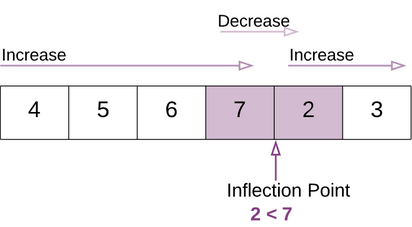
arr = [4, 5, 6, 7, 0, 1, 2, 3]
Our inflection point above is 4 - this means we have 2 arrays:
arr[inflection: ]which is[0, 1, 2, 3]arr[0: inflection]which is[4, 5, 6, 7]- Both of these are sorted arrays! We can run regular ol' binary search on these 2 arrays, but we need to figure out:
- Where the inflection point is
- If our target is in the left
arr[0: inflection]array, or the rightarr[inflection: ] - Looping over array to find the inflection point is , and so problems that say "You must write an algorithm with runtime complexity." make this a bit trickier
We can find the inflection point in !
left = 0
right = len(arr)
...
mid = left + right // 2
if check(mid):
    return(mid)
elif mid > first element of array:
    search to the right
else:
    search to the left
because if you find the number 6, which is above the first element 4, you know our inflection point is still to the right of us, but if you find 0, 1, 2, 3, we know it's to the left
So in total there are 2 binary searches in these types of problems:
- Finding the inflection point
- Splitting up the array based on inflection point and target, and running a typical binary search there
class Solution:
    def search(self, nums: List[int], target: int) -> int:
        if len(nums) < 2:
            return(0 if nums[0] == target else -1)

        # find inflection point
        left = 0
        right = len(nums)

        # [4, 5, 6, 7, 0, 1, 2, 3]
        while left < right:
            mid = left + (right - left) // 2

            # we know inflection is to the right
            # left being mid could still be the right one though
            if nums[mid] >= nums[0]:
                left = mid + 1         # [mid, right)

            # inflection point to the left
            else:
                right = mid

        inf_point = left if left < len(nums) else 0

        if inf_point != 0 and target < nums[0]:
            left, right = inf_point, len(nums)
        else:
            left, right = 0, inf_point if inf_point != 0 else len(nums)

        while left < right:
            mid = left + (right - left) // 2
            if nums[mid] == target:
                return(mid)
            elif nums[mid] > target:
                right = mid
            else:
                left = mid + 1

        return(-1)
Rotating List Without Initial Pivot Search
There is an actual way to run binary search on a rotated array without initially finding the pivot and splitting
In the rotated array problems there are 3 indices we need to utilize at every step:
leftmidright
We need all 3 of these to be real and index-able, because we are using them in comparisons to find a specific number. These usually aren't boundary problems, so you can do safe updates like mid - 1 and mid + 1 as well. Therefore, it's usually more beneficial to utilize a closed interval template so that all of the indexes exist, and we are fully able to make greedy updates to the search space
from typing import List

class Solution:
    def search(self, nums: List[int], target: int) -> int:
        left, right = 0, len(nums) - 1   # closed interval [left, right]

        while left <= right:
            mid = left + (right - left) // 2

            if nums[mid] == target:
                return mid

            # left half is sorted
            if nums[left] <= nums[mid]:
                if nums[left] <= target < nums[mid]:
                    right = mid - 1
                else:
                    left = mid + 1

            # right half is sorted
            else:
                if nums[mid] < target <= nums[right]:
                    left = mid + 1
                else:
                    right = mid - 1

        return -1
Peaks
Finding peak elements can be seen as a form of binary search where you are looking for some bounday [inc, inc inc, dec] where on the left there's an increasing sequence, and on the right there's a decreasing sequence - you could have an array similar to [1,2,3,4,3,5,6,7] where 4 is a peak, but you can't necessarily tell unless you're exactly at that index
There's a nuance to most of these problems in the stated assumptions - "You may imagine that nums[-1] = nums[n] = -inf. In other words, an element is always considered to be strictly greater than a neighbor that is outside the array."
Therefore, the update logic would need to be based on if we're currently in an index in an increasing sequence or not:
- If a certain index
midis sitting in a descending sequence of numbers, i.e. a local falling slope, it means the peak will always lie to the left of this element - Therefore, we can reduce the search space to the left of this element via
right = mid - If
midlies in an ascending sequence of numbers, it implies the peak element lies towards the right of this element, with our typicalleft = mid + 1update
class Solution:
    def findPeakElement(self, nums: List[int]) -> int:
        if len(nums) <= 1:
            return(0)

        left = 0
        right = len(nums)

        while left < right:
            mid = left + (right - left) // 2

            # if we can safely check both indexes around us
            if 0 < mid < len(nums) - 1:
                if nums[mid - 1] < nums[mid] > nums[mid + 1]:
                    return(mid)
                # means we're in an increasing sequence
                elif nums[mid - 1] < nums[mid]:
                    left = mid + 1
                # we're in decreasing
                else:
                    right = mid

            # we're at one of the ends - logic here is screwy with short arrays like [1,2], and [2,1]
            elif mid == 0:
                if nums[mid] > nums[mid + 1]:
                    return(mid)
                else:
                    left = mid + 1
            else:
                if nums[mid - 1] < nums[mid]:
                    return(mid)
                else:
                    right = mid - 1

        return(left)
Find A Rate
There are some specific problems like KoKo Eating Bananas and Elves on Package Line where you basically need to find a rate of something, and then check if that rate suffices
Koko's eating rate, maybe it's 3 bananas-per-hour, and if that works then we'd look if a higher rate would suffice like 10-per-hour, etc...
Usually this would mean the rate finding is where is the rate search space, and then there'd be an input array of size that you must check through. The check function is typically so in total it's versus
Otherwise, you just continuously check the rate instead of "smart searching" using binary search
Structures
Lists and Tree's are typically the data structures that you see with Binary Search
Lists
There's some gotchas for list, mostly around defining right and left, and different vs , but altogether the pseudocode is pretty easy Pseudocode for list:
# list of 10 nums
nums = sorted(list)
val_to_find = get_num()

left = 0
right = len(nums)

while left <= right:
    # 0 + (10 - 0) // 2 = 5 // 2 = 2
    mid = left + (right - left) // 2
    if check(val):
        left = mid + 1 # or left = mid
    else:
        right = mid - 1 # or right = mid


return(-1)
Tree
In a binary search tree, there's some special properties where, for any Vertex V, it's right child is greater than it's value, and its left child is less than it's value
Ultimately it's just a way to restructure a Linked List so that search is in time - this entire concept is the idea of Self-Balancing Binary Search Trees such as B-Tree's. Self balancing tree's have less efficient writes (since they need to find where to place nodes and do some restructuring), but the idea is that reads are much more efficient
A Binary Search Tree has similar code structure to Lists
def search_bst(root, target):
    while root is not None:
        if root.val == target:
            return True
        elif target < root.val:
            root = root.left
        else:
            root = root.right
    return False